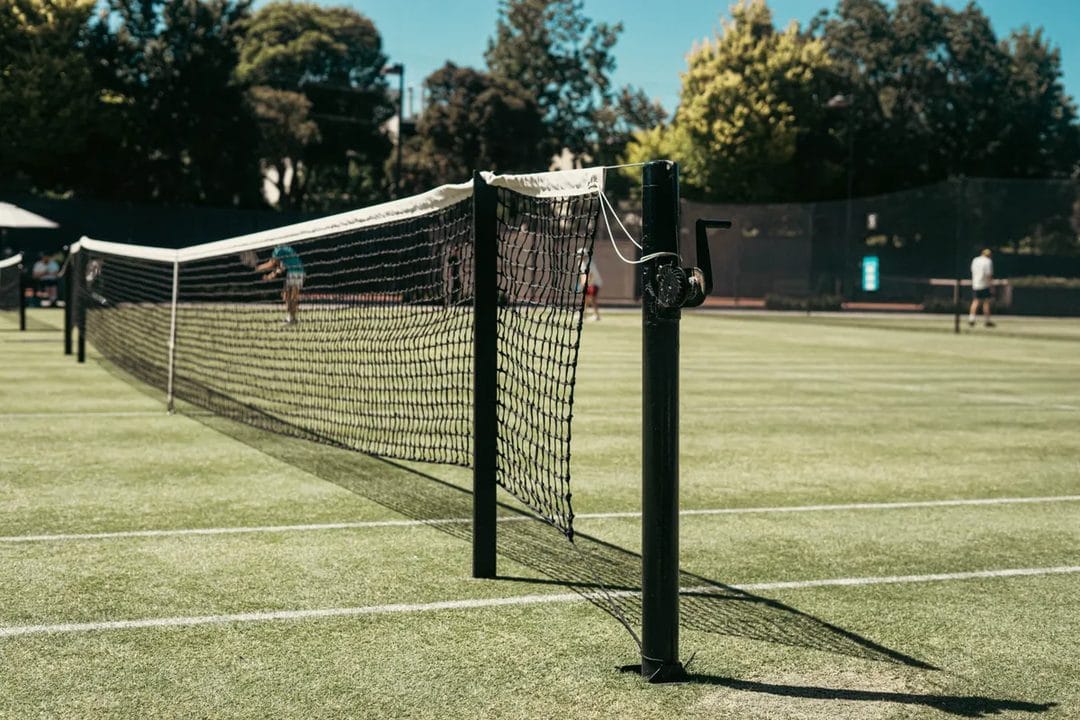
Something changes in a professional tennis player's body the moment their shoes touch grass for the first time in a season. The knees sit lower. The first step off a serve return fires half a beat earlier than it did on clay three weeks prior, because the ball simply won't wait for a full unit turn. Players and coaches working the practice courts at the All England Club talk about the opening days on grass almost like a return from injury — not because anyone is hurt, but because movement patterns that worked perfectly on clay or hard courts stop working overnight, and the body has to relearn them fast, usually inside a two-week window that starts right after Roland-Garros ends.
Grass Turns Every Point Into a Sprint, Not a Rally
The defining physical fact about grass is how short the points are. Ball speed off the surface stays high because grass offers minimal friction, and the bounce sits low and skidding rather than kicking up around shoulder height the way clay does. On the ATP and WTA tours, grass-court rallies routinely average somewhere around three to four shots per point — roughly half the length of a typical clay-court exchange. That single number reshapes the entire training model: a player preparing for Wimbledon isn't building the long aerobic engine that carries someone through a five-hour clay marathon. They're building an athlete who can produce ten to fifteen maximal accelerations per game, recover for twenty seconds between points, and repeat that pattern forty or fifty times across a set without the legs going flat by the fourth game.
This is where a lot of amateur and even some professional programming gets it backwards. Distance running and long tempo sessions have almost no transfer to what a grass-court match actually asks of the body. Sprint the sets — repeated 10-to-15-metre efforts with a full ninety seconds of rest, structured to mimic the stop-start rhythm of a changeover-heavy, short-rally surface — and you train the actual energy system in play. Steady-state cardio, by contrast, builds an engine for an event that doesn't exist on Centre Court.
Reaction Time Beats Raw Speed
Because the ball arrives faster and lower, the split-step timing window on grass shrinks by a fraction of a second compared with clay. Elite grass-court movers aren't necessarily the fastest players on tour in a straight-line sprint test — they're the ones whose first two steps fire before conscious decision-making finishes, which is a trained reaction pattern, not a raw-speed trait. Coaches drill this with reaction-ball work and reflex volleys at the net long before players ever set foot on a grass court, precisely because grass offers zero margin for a late first step.
Low and Loaded: Why Grass-Court Footwork Looks Different
Watch any player who moves well on grass and the centre of gravity sits noticeably lower than it does on hard courts — knees bent deeper, hips loaded, weight forward on the balls of the feet rather than settled back on the heels. That posture exists for a specific mechanical reason: grass gives slightly under the foot on push-off, and a higher, more upright stance loses stability the instant lateral force gets applied. Sliding, which has become a signature defensive tool on clay, barely works on grass at all — the surface doesn't offer a controlled slide, it offers a slip, and the difference between the two ends careers.
- Shorter, choppier adjustment steps replace the long clay-court slide, keeping the base of support under the body at contact.
- Lateral bounding and lunge work in the gym translate directly, because both demand eccentric control through a bent knee under load — exactly what grass asks for on every direction change.
- Ankle stability training matters more here than on any other surface; a rolled ankle from an unstable push-off is the single most common reason a seeded player retires mid-match at Wimbledon, and conditioning staff treat proprioception drills as non-negotiable, not optional extras.
The Surface-Transition Problem Nobody Talks About Enough
Grass doesn't forgive a slow adaptation — it just quietly ends tournaments in the first round.
Here's the part that gets underrated: the switch from clay to grass is one of the most abrupt surface transitions in professional sport, and players get roughly two to three weeks to make it. Roland-Garros finishes in early June; the grass-court swing, including Queen's and Eastbourne, opens almost immediately after. A body that spent five weeks sliding into open stances on slow, high-bouncing clay has to reprogram for a surface that rewards closed stances, flatter shots, and instant deceleration. Some players never fully make that switch — which is exactly why the same names who dominate clay rarely dominate grass, and it's a pattern that has held for decades, not a coincidence of any single season.
Skip the transition training and the results show up as soft-tissue injuries in week one, not week three. That's the uncomfortable truth strength staff have to manage: a player arriving fit from a deep Roland-Garros run can still be under-prepared for grass specifically, because "fit" on clay and "prepared" for grass are not the same physical state. The better programs build a short, deliberate grass-adaptation block — low-volume, high-intensity movement sessions on an actual grass surface, done at reduced intensity for the first two or three days — rather than assuming general fitness will simply carry over.
What Changes in the Shoulder and Serve Chain
Grass also rewards a flatter, more penetrating serve because the low bounce takes the second-serve kick out of play as a reliable weapon. That shifts load through the shoulder differently across two weeks of matches, and conditioning staff who ignore it tend to see rotator cuff fatigue creep in by the second week — right when it matters most.
Recovering Between Best-of-Five Matches Over Thirteen Days
Men's singles at Wimbledon is still played best-of-five sets, and that format compounds every physical demand above across a tournament that runs thirteen days with, at most, one rest day between rounds in the early stages. Since 2019, Wimbledon has used a final-set tiebreak at 12-12 rather than letting deciding sets run indefinitely — a direct response to matches like the 2010 Isner–Mahut first-round contest, which lasted eleven hours and five minutes across three days. That rule change matters for recovery planning: medical and performance staff can now build a recovery protocol around a match that has a known outer time limit, instead of one that could theoretically never end.
The recovery window itself is short and unforgiving. A player who finishes a five-set match at 8pm has roughly forty hours before their next contest if the tournament schedules them for day-after-next, and closer to sixteen if there's a back-to-back. Cold-water immersion in the fifteen minutes immediately after the final point, compression garments overnight, and a carefully sequenced sleep-first recovery schedule — sleep before treatment, treatment before food, in that order — are standard on tour now, not optional extras reserved for the top four seeds. Skip the immediate post-match cooling window and inflammation markers stay elevated into the next day's warm-up, which shows up as a step slower on exactly the point that decides a set.
The Case for Prioritising Sleep Over Extra Practice
One recommendation worth stating plainly: players and coaches who use an off-day for extra practice hours instead of protected sleep and passive recovery are making the wrong call almost every time during a grass-court fortnight. The marginal technical gain from an extra hour on court doesn't come close to matching what a full recovery cycle buys back in reaction speed two days later — and reaction speed, on a surface this fast, is the difference between a clean pass down the line and a rushed error into the net.
What This Means for the Rest of the Sport, Not Just Tennis
The training logic behind grass-court tennis has quietly influenced conditioning in other short-burst, high-deceleration sports — badminton, squash, even football wingers doing repeated-sprint protocols borrow directly from what tennis strength coaches built for the grass swing. The common thread across all of it: short maximal efforts, incomplete recovery between reps, and eccentric strength through a bent knee beat long steady-state work every time the sport itself demands a sub-five-second burst rather than a sustained effort. That's not a controversial claim inside performance labs anymore — it's closer to consensus, even if recreational training culture is still catching up to it.