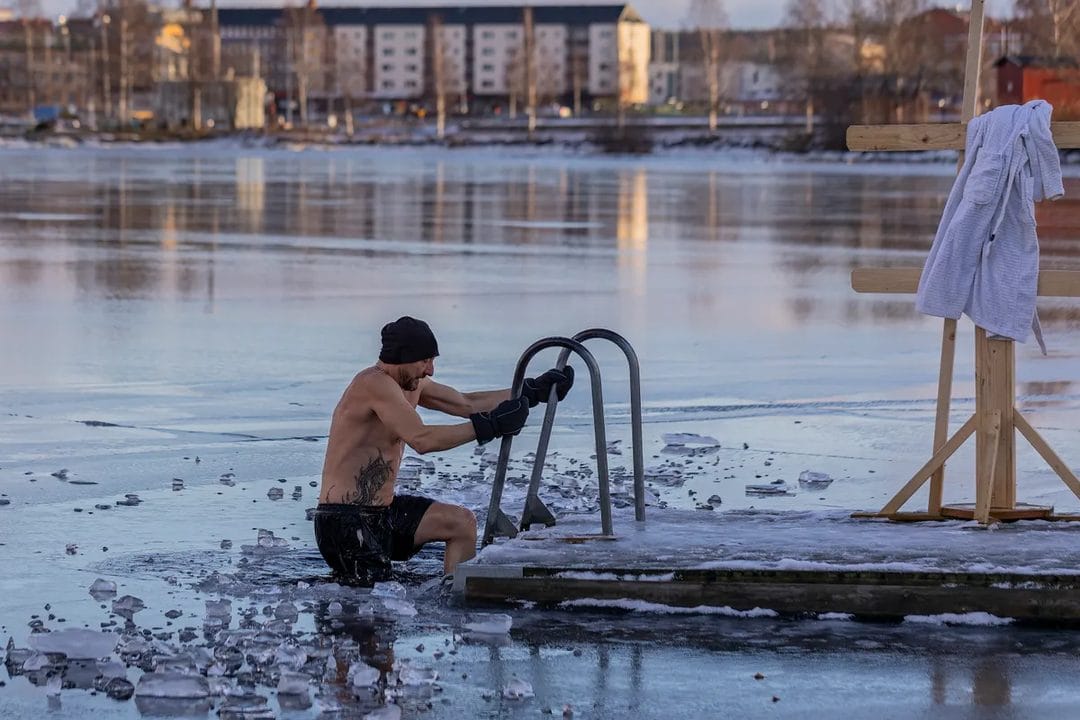
The 2015 study that made strength coaches nervous
For most of the 2010s, the post-lifting ice bath was treated as a free win — hop in for ten minutes, feel less sore the next day, get back to training sooner. Then a study published in The Journal of Physiology in 2015 tested that assumption directly. Researchers ran a group of recreationally trained men through 12 weeks of lower-body strength training, with one leg getting a cold water immersion session (roughly 10°C for 10 minutes) immediately after each workout and the other leg getting active recovery on a bike instead. By the end of the block, the cold-water leg had gained noticeably less strength and less muscle cross-sectional area than the leg that just pedalled it out.
That result mattered because it wasn't just a soreness or perception effect — the researchers also biopsied muscle tissue and found blunted activation of the signalling pathways that drive hypertrophy, including reduced phosphorylation of p70S6K, a marker downstream of mTOR that tracks pretty reliably with whether a training stimulus is going to turn into new muscle. Cooling the tissue right after a hard set appears to dampen exactly the biochemical cascade that resistance training is trying to trigger. For a recreational lifter chasing general fitness, that's a footnote. For a powerlifter, a rugby prop, or an NFL guard trying to add ten pounds of functional mass over an off-season, it's a different problem entirely.
What's actually happening inside the muscle
The mechanism isn't fully settled, but the leading explanation ties back to inflammation. Hard resistance training causes controlled muscle damage, and the immune response to that damage — neutrophils and macrophages moving in, satellite cells activating, local blood flow increasing — isn't just cleanup. It's part of the adaptation signal itself. Cold water immersion constricts blood vessels and suppresses that inflammatory response by design, which is exactly why it reduces next-day soreness. The trouble is that the same vasoconstriction appears to choke off the nutrient delivery and cell signalling that satellite cells need to fuse into muscle fibres and drive long-term growth. This is the part that trips people up: less inflammation and less soreness feels like a good outcome in the moment, and it is, if the priority is showing up ready for tomorrow's match. But if the priority is the training adaptation itself — getting stronger over a 12-week block rather than feeling fresher for a Tuesday session — blunting that inflammatory signal is working against the goal. Sports scientists sometimes describe this as training two different variables that happen to look identical on the surface: recovery, and adaptation. An athlete can optimise one at the direct expense of the other, and cold water immersion is one of the clearest cases where that trade-off actually shows up in a muscle biopsy rather than just a training log.
Who's actually pulling back
Strength and conditioning staff working with athletes whose central goal is added lean mass — offensive linemen, throwers, weightlifters, front-row forwards — have increasingly moved the ice bath away from lifting days entirely, or at minimum away from the two-to-four hour window right after a session. Some programmes now separate cold exposure from resistance work by six hours or more, on the logic that the anabolic signalling window has mostly closed by then and the athlete can still get whatever perceptual recovery benefit the cold offers without interrupting the biochemistry. Others have swapped post-lifting ice baths for contrast water therapy (alternating hot and cold) or simply active recovery, both of which don't appear to carry the same suppression of muscle protein synthesis in the available research. Not every programme has made this switch, and that's worth saying plainly. A lot of team environments still default to the ice tub because it's cheap, athletes like the ritual of it, and the coaching staff has never run a controlled comparison of their own. The Roberts 2015 protocol used young, recreationally trained men rather than elite, highly trained athletes, and it's a fair question whether well-adapted muscle responds identically — some later work on trained populations has shown smaller effect sizes than the original study, which is one reason this hasn't become a blanket ban so much as a case-by-case call.
A follow-up study out of Deakin University in 2017, led by exercise physiologist Jackson Fyfe, added a wrinkle to the original finding rather than simply confirming it: cold water immersion blunted hypertrophy — the muscle didn't grow as much — but strength gains in some lifts weren't affected to the same degree. That distinction matters for programming. A weightlifter chasing a heavier one-rep max and a bodybuilder chasing cross-sectional area are, biologically, training for two different outcomes, and the research so far suggests cold water immersion is more of a hypertrophy problem than a pure-strength problem. Coaches working with athletes whose sport rewards mass — line play, throwing events, heavyweight wrestling — have the strongest reason to be cautious; coaches working purely for maximal strength in a lighter weight class have a weaker case for cutting the ice bath altogether.
Where cold water immersion still earns its place
None of this means the ice bath is finished in elite sport — it just means the calculation flips depending on what the calendar actually demands. Rugby sevens, cricket's T20 formats, wrestling and judo tournaments run on a same-day, repeated-bout structure where an athlete might compete three or four times before the sun goes down. In that context, a marginal hit to long-term hypertrophy signalling is irrelevant; what matters is walking onto the mat or the pitch again in ninety minutes with legs that still work. Cold water immersion's well-documented ability to reduce perceived soreness and restore power output faster over a 24–48 hour window is exactly the tool tournament sport needs, even if it's the wrong tool for a Tuesday squat session in November.
Endurance sport tells a similar story from a different angle.
Cyclists and distance runners aren't chasing the same hypertrophy signal a rugby prop is, so the anabolic trade-off barely applies to them in the first place — a marathoner's training adaptations run through mitochondrial density and capillarisation rather than the mTOR pathway cold water immersion interferes with. For that population, the calculus is much closer to a straightforward efficiency question: does the cold plunge get you back on the start line in better shape for tomorrow's stage or heat, and the answer during multi-day races and tournament weeks is usually yes. That's also why the same governing bodies and medical staff who've grown cautious about ice baths for their strength athletes keep cold tubs parked trackside for their endurance squads without much internal debate.
Commercial cold plunge equipment has made the choice easier to act on, for what it's worth. Units from brands like Plunge and Ice Barrel now sit in enough private training facilities that athletes can time their own cold exposure independently of the team ice tub — take the plunge in the evening, six or eight hours after the weight room, rather than immediately after the last set. That single scheduling change is doing most of the practical work here: the athlete still gets whatever sleep-quality and subjective-recovery benefit cold exposure offers, without parking it inside the two-to-four hour window where it appears to interfere with the muscle's own repair signalling.
The protocol most programmes actually run now
Where teams have adjusted, the change is rarely "never ice" — it's a scheduling fix. The most common approach separates cold exposure from the resistance session by at least six hours, which lets an athlete still use ice for the perceptual and sleep-quality benefits later in the day without dousing the signalling window immediately after training. Temperature and duration also matter more than most athletes assume: 10–15°C for 10–15 minutes is the range most of the research has actually tested, and colder isn't better — it just increases discomfort without adding measurable recovery benefit. Programmes chasing hypertrophy as the primary goal are more likely to swap the post-lifting cold plunge for a warm-up shower and active recovery, keeping the ice bath in reserve for congested competition weeks when next-day availability outranks the training adaptation.
Cold water immersion right after a heavy lifting session is a trade, not a free recovery tool — and which side of that trade an athlete should take depends on one question: is tomorrow another training block, or another match?