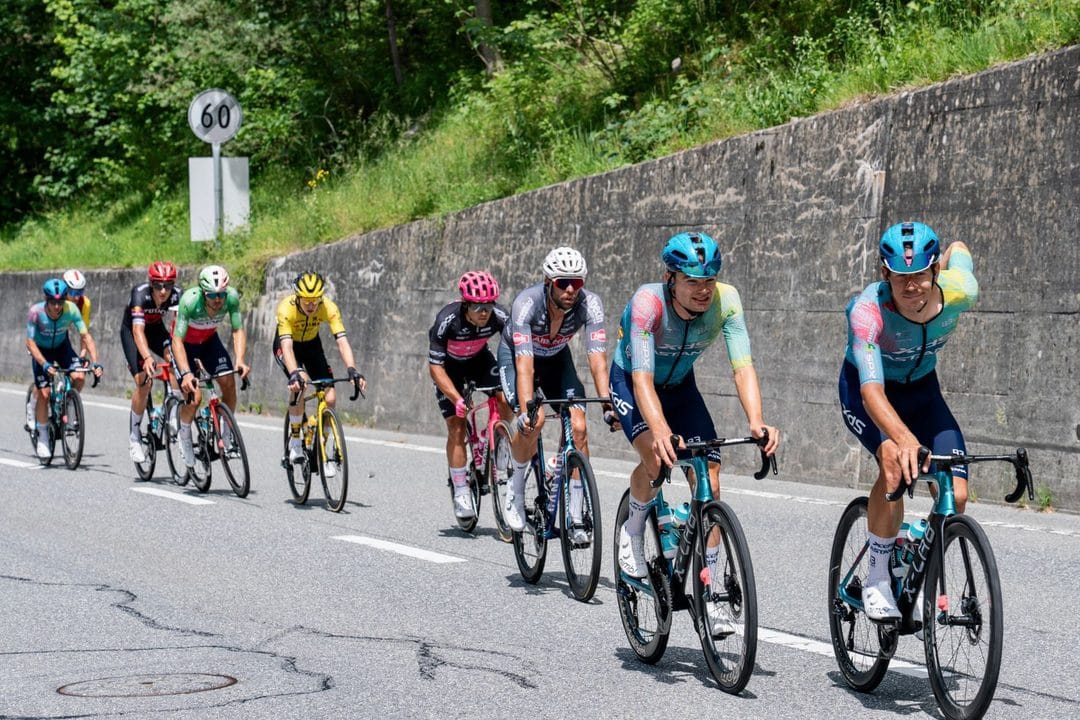
Enric Mas was not supposed to be riding for himself in Granada on 13 September. For the first six stages of the 2026 Vuelta a España, that job belonged to Tadej Pogačar, who had won three of them and looked, as usual, unbeatable over three weeks. Then came stage 8, a crash that ended Pogačar's race and, within it, ended the version of the Vuelta that Movistar's coaches had spent the winter planning for. Mas, second overall when Pogačar abandoned, inherited the red jersey, won stage 9 outright, and held the lead for the remaining twelve stages to finish 2 minutes 15 seconds clear of Primož Roglič. It reads like a story about luck. It is really a story about what happens inside a rider's body and a team's logistics when a three-week race plan has to be rebuilt overnight.
A Race Plan Torn Up on Stage 8
Grand tour campaigns are periodised months in advance. Training blocks, altitude camps, taper windows and race-day nutrition are all built around one rider's physiology and one projected role for everyone else on the roster. Movistar's plan for the 2026 Vuelta a España — 21 stages, 3,310.6 kilometres, starting in Monaco on 22 August and finishing in Granada three weeks later — had Mas riding as Pogačar's closest rival for the overall, not as a man defending his own jersey for thirteen consecutive days. When Pogačar crashed and abandoned, the team did not just lose a favourite. It lost the pacing model, the recovery protocol and the tactical hierarchy that every other rider on the roster had trained around for months.
What replaced it had to be built in hours, not weeks. Directeurs sportifs had to reassign domestiques who had spent the opening week protecting a rider chasing stage wins to instead ride tempo for a GC leader trying to defend seconds. Soigneurs had to shift recovery nutrition from a rider who could afford occasional high-risk efforts to one who now needed conservative, repeatable output for two more weeks. None of this shows up in a results sheet. All of it decides whether a promoted rider survives the third week or fades in it.
What Actually Changes When a Support Rider Becomes the Leader
The physiological gap between riding as a protected co-leader and riding as the sole GC leader is bigger than casual fans assume. A rider positioned to finish second overall can afford to lose small amounts of time in crosswinds, sit further back in the bunch on flat stages, and let a break go if it poses no threat. A rider defending the leader's jersey cannot. Every echelon, every attack from a rider ten minutes down on GC, every mechanical at the wrong moment demands a response — which means dozens of small, unplanned surges above threshold power that were not in the original training model for that rider's role.
Sports scientists who study grand tour load distinguish between "protected" and "exposed" racing precisely for this reason: the total kilojoule expenditure across a stage can look similar on a power file, but the variability — the number of hard accelerations, the time spent chasing rather than following — is what accumulates fatigue unevenly across three weeks. A rider who has trained to produce one or two hard efforts per stage suddenly needing six or seven is not just tired. He is tired in a different physiological currency, drawing down glycogen and central nervous system reserves that his taper and race-week fuelling were never built to replace at that rate.
The Numbers That Decided Granada
Mas crossed the line in Granada in a combined time of 73 hours, 52 minutes and 55 seconds. Roglič finished second at plus 2:15, Felix Gall third at plus 2:44, Richard Carapaz fourth at plus 6:54, and Sepp Kuss fifth at plus 8:45. Those gaps look comfortable in a results table. They were not comfortable to hold for thirteen days by a rider who had not trained, mentally or physiologically, to be the one everyone else in the race was racing against.
- Winning margin: 2 minutes 15 seconds over Primož Roglič (Red Bull–Bora–Hansgrohe)
- Route: Monaco, France, Andorra and Spain across 21 stages and 3,310.6 kilometres
- Jersey change: stage 8, following Pogačar's crash and withdrawal
- First Spanish overall winner of the Vuelta in twelve years — the last was Alberto Contador
Oscar Onley of Netcompany INEOS took the young rider classification while finishing sixth overall, Santiago Buitrago won the mountains jersey for Bahrain Victorious, and Wout van Aert claimed the points title alongside the race's overall combativity award. None of those results change the central fact of the race: a rider who began the Vuelta as a co-favourite finished it having defended a lead for longer, under more scrutiny, than almost anyone on the start list had trained to do.
Roglič's Familiar Third-Week Pattern — and Its Limits
If anyone in the peloton understood the physiological arithmetic Mas was facing, it was the man who finished second. Roglič has now completed six career editions of the Vuelta a España without ever finishing off the podium, and three of those appearances — 2019, 2020 and 2021 — ended in outright victory. His reputation for building strength through a three-week race rather than fading in it is not folklore; it shows up consistently in how his power numbers trend across grand tours, with less drop-off in the final week than most climbers his age. That pattern held again in 2026. Roglič lost time early, clawed it back through the second half of the race, and turned the final mountain stages into the only real threat to Mas's lead.
It did not turn into a fourth title, and that gap is instructive on its own. Coming alive in week three is a genuine physiological advantage — a product of years of training a body to tolerate accumulated fatigue without the usual drop in mitochondrial efficiency — but it cannot manufacture two minutes and fifteen seconds out of nothing if the rider ahead simply does not crack. Mas never gave Roglič the opening that a fading leader usually provides.
The Risk Teams Rarely Admit to Publicly
Movistar's improvisation worked. It does not always. Cycling's recent history is full of hastily promoted co-leaders who looked strong for a week and then lost several minutes in a single bad stage once the accumulated load of unplanned efforts caught up with them — the classic pattern being a rider who holds a lead comfortably through the second week and then loses it abruptly, often on a stage that looks unremarkable on paper. Teams rarely discuss this risk in public because doing so would mean admitting that a Grand Tour title can hinge as much on which rider's body tolerates an unplanned role change as on raw climbing ability.
The honest version of Mas's win, then, is not that Movistar simply got fortunate when a rival crashed. Plenty of teams have been handed a leadership vacancy mid-Grand Tour and failed to convert it, precisely because the physiological cost of the switch outweighed whatever tactical advantage the vacancy created. Mas and his staff deserve more credit for managing that transition cleanly than the "underdog inherits the jersey" framing usually allows.
What This Means for How Teams Build Grand Tour Squads
Expect more WorldTour teams to build contingency load models for their second-ranked GC rider before the next Grand Tour season starts, rather than treating that rider purely as insurance. Movistar's staff effectively had to write a new race plan for Mas in the hours after stage 8 — reworked recovery windows, altered domestique assignments, a different pacing script for the mountain stages that followed. Building even a rough version of that plan in advance, before it is needed, is the more sensible way to run a modern GC roster.
That is a harder sell to sponsors than announcing a single, unambiguous team leader before the race even starts. But Granada showed what the alternative costs when it goes wrong, and what it can deliver, twelve years after Contador, when it goes right.