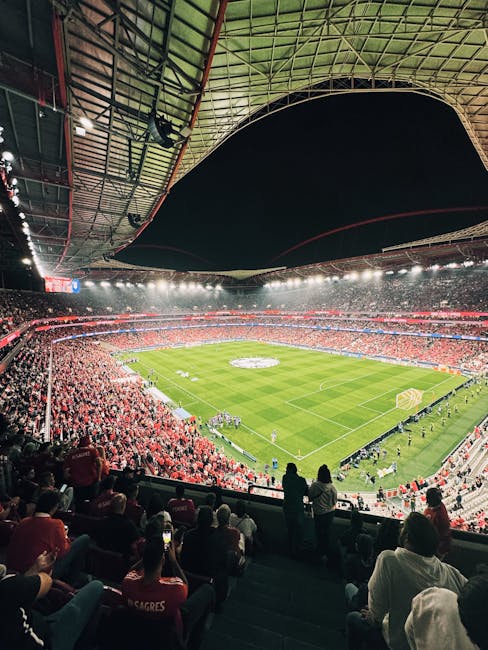
The Champions League quarterfinal draw, held at UEFA headquarters in Nyon on March 14, produced four pairings with significant tactical interest: Real Madrid vs. Arsenal, Barcelona vs. Borussia Dortmund, Manchester City vs. Atalanta, and Bayern Munich vs. Inter Milan. The quarterfinal first legs begin April 8, with return legs on April 15 and 16.
Opta's supercomputer projection places Real Madrid as the eventual winner at 26 percent probability, followed by Manchester City at 19 percent and Arsenal at 13 percent. The projection represents the closest clustering of the top three favorites since the current format changed in 2024-25.
Real Madrid vs. Arsenal
Real Madrid's route to the quarterfinals included a 7-2 aggregate demolition of Celtic in the round of 16, a reminder of the gap between Europe's elite and the Scottish Premiership. Arsenal advanced past Real Betis with a 4-1 aggregate victory, highlighted by Viktor Gyokeres's hat trick in the first leg at the Emirates.
The tactical matchup favors Real Madrid's possession-based approach against Arsenal's pressing. Real's 59.2 percent average possession and 83 percent pass completion rate in the Champions League league phase suggest they can neutralize Arsenal's 11.5 pressures per possession. Jude Bellingham, who has 11 goals and 7 assists in his Real Madrid career to date in the Champions League, is expected to play in an advanced role alongside Kylian Mbappe.
Barcelona vs. Borussia Dortmund
Barcelona's quarterfinal opponent Borussia Dortmund produced the round of 16's biggest upset — a 2-0 first-leg victory away at Paris Saint-Germain, followed by a 1-1 draw at Signal Iduna Park. The Dortmund squad, coached by Nuri Sahin in his first full season, has relied on counter-attacking football against top-flight opponents. Dortmund have scored 13 of their 21 Champions League goals this season from direct counter-attacks.
Barcelona's tactical approach under head coach Hansi Flick emphasizes high defensive lines and pressing. This contrasts with Dortmund's counter-attacking profile and creates a matchup that should produce clear statistical separation. Flick has told Catalan radio that Barcelona "must not give Dortmund the space they want, but that is easier said than done."
Manchester City vs. Atalanta
Manchester City's round of 16 victory against Atletico Madrid — 4-2 on aggregate — came despite Rodri's absence, with Mateo Kovacic filling the defensive midfield role. City's tactical discipline in the second leg, particularly in the final 30 minutes of a 1-1 draw at Atletico's Metropolitano Stadium, demonstrated head coach Pep Guardiola's ability to adapt his scheme.
Atalanta, the 2024 Europa League champion, reached the quarterfinals after defeating Real Madrid in a statistically upset 4-3 aggregate result. The Bergamo club's 3-4-2-1 formation and aggressive pressing represent a stylistic challenge that Manchester City has not faced in this Champions League cycle. Atalanta head coach Gian Piero Gasperini has publicly committed to maintaining his aggressive philosophy rather than adjusting tactically for City.
Bayern Munich vs. Inter Milan
Bayern Munich, with Vincent Kompany in his second season as head coach, advanced past Bayer Leverkusen 4-2 on aggregate. The Munich club's tactical identity under Kompany — high possession, pressing-based football — has been described by the head coach as "a direct continuation of the Pep Guardiola years under Hansi Flick." Harry Kane has scored 8 Champions League goals this season, the second-highest tally.
Inter Milan, under Simone Inzaghi, reached the quarterfinals by beating Feyenoord 3-1 on aggregate. Inzaghi's 3-5-2 formation has been Italian football's most consistent structure over the past four seasons, with Inter reaching the 2023 Champions League final. The tactical matchup — Bayern's possession against Inter's structured counter-pressing — is one of Europe's most-discussed stylistic contrasts.
Expected Goals Models
Opta's supercomputer assigns each quarterfinal a most-likely aggregate score: Real Madrid 3-2 Arsenal, Barcelona 3-1 Dortmund, Manchester City 2-1 Atalanta, and Bayern Munich 2-1 Inter Milan. The totals reflect the model's valuation of home-leg advantages and team-strength differentials.
The xG models have particular predictive strength in two-leg ties. Opta's 2024-25 quarterfinal predictions correctly projected three of four eventual advancers, with only the Real Madrid vs. Manchester City tie confounding the model. For 2025-26, the model projects all four of the above matchups with probability above 58 percent.
Home-Second Bias
The home-second leg advantage in Champions League two-leg ties has risen to 58 percent since the format change in 2024-25, up from the historical 52.5 percent. Real Madrid, Arsenal, Barcelona and Inter Milan all play their second legs at home in 2026 quarterfinals, potentially benefiting from the structural advantage.
UEFA has initiated a review of the single-draw knockout bracket format, which critics argue amplifies the home-second effect. Any changes would not take effect until the 2027-28 season. The UEFA executive committee is scheduled to discuss the review at its September 2025 meeting.
Tactical Trends
The Champions League 2025-26 tactical trends include higher average possession among top teams (59.8 percent, up from 57.1 percent in 2023-24), reduced pressing intensity (PPDA of 11.2, versus 10.4 in 2023-24), and a significant rise in set-piece scoring (14 percent of total goals, up from 9.8 percent). The combination suggests Europe's elite clubs are playing more controlled football while remaining effective on set-pieces.
This trend is consistent with the tactical direction set by the four remaining quarterfinal favorites. Real Madrid, Manchester City, Barcelona and Bayern Munich all operate with possession-based schemes. The fact that all four lead the Champions League's set-piece scoring — combined, they have scored 17 set-piece goals — suggests the tactical trend is self-reinforcing.
Television and Broadcast
UEFA's 2026-29 broadcast rights package, worth an estimated €4.4 billion annually across Europe, begins with the 2026-27 season. CBS Sports retains U.S. English-language rights through 2030 for a fee of $275 million per year, up from $180 million in the previous cycle. UEFA TV's direct-to-consumer streaming service, launched in 2022, has grown to 12 million paid subscribers globally.
The quarterfinal matches will be broadcast live in more than 220 countries. UEFA's estimated 450 million cumulative audience for the knockout rounds represents a 14 percent increase from 2024-25.