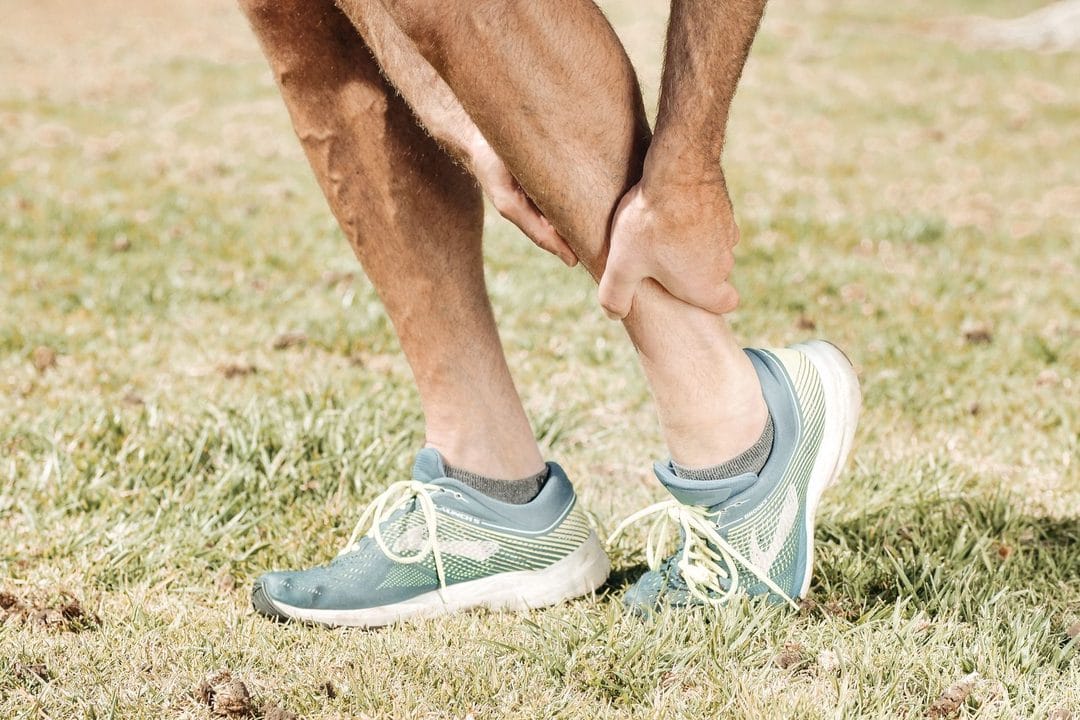
Most runners who develop Achilles pain follow the same script. The first morning the heel feels stiff, they cut back. The second week they stop altogether, and by the third week the tendon feels worse than it did before the break. Then the run comes back, and so does the ache, usually a little earlier than expected. The problem is rarely that the tendon was overused in the abstract. It is that it was left without the one stimulus it needs to rebuild, which is controlled load.
The load is what this piece is about: why rest is often the wrong first move for midportion Achilles tendinopathy, what the tendon responds to, and how to keep training while it catches up. It is written for competitive runners and serious recreational athletes, the people who cannot afford twelve weeks on the sofa and who have already tried the foam roller.
Why rest is the wrong first instinct
Tendons are not muscles, and they do not respond to rest the way muscles do. A strained calf can settle in a few days of relative inactivity because the muscle fibres regenerate quickly and the blood supply is generous. Tendon tissue is different. It is dense, relatively avascular, and it turns over slowly. What it adapts to is mechanical stress, and it adapts to that stress over months rather than days.
When you stop loading a tendon, it does not heal in any useful sense. It becomes less capable of handling force. The collagen fibres that were aligned for running gradually lose that alignment, and the tissue becomes less tolerant of the next session. That is why a runner who takes three weeks off often returns to the same distance and finds the heel complaining at kilometre four rather than kilometre twelve. The rest was not neutral. It removed the signal the tendon was waiting for.
There are exceptions. A sudden sharp pain with a popping sensation, a loss of push-off strength, or a gap you can feel under the skin all need a proper medical assessment, and in the case of a suspected rupture, a fast one. Everything below assumes a gradual onset of pain in the mid-tendon, typically two to six centimetres above the heel bone, that is worse in the morning and after hard sessions. If that matches your picture, the sensible plan is to load the tendon in a measured way, not to wait for it to feel better first.
What the tendon is actually asking for
The clearest guide to how much load is tolerable comes from the pain-monitoring model that Silbernagel and colleagues developed and that many physiotherapists now use in clinic. The rule is simple. Some discomfort during an exercise session is acceptable, provided it stays at about 5 out of 10 or below, returns to baseline within 24 hours, and the next morning is no worse than the one before. If pain climbs beyond that, or the tendon is clearly more sore the following day, the load was too high and should be reduced for the next session.
This matters because the two things most runners do by reflex, stopping at the first twinge and pushing through regardless, both break the feedback loop. Stopping removes the stimulus. Pushing through ignores the warning. The pain-monitoring approach sits between them and treats the tendon's reaction as data. Keep a note of the number, the morning stiffness and the session load for two weeks. Patterns appear quickly, and they are far more useful than a general sense of whether things are getting better.
The eccentric heel drop, done properly
The eccentric heel drop is the best-known protocol and the one with the longest track record in Achilles research. The original work by Alfredson and colleagues in the late 1990s used three sets of fifteen repetitions, performed twice a day, for twelve weeks. Each repetition is done standing on the edge of a step, rising onto the toes of both feet, then lowering the heel slowly on the affected side below the level of the step. The lowering phase should take around three seconds. The rising phase can be done with both legs.
Two details are often missed. The first is that the exercise is done with the knee straight and then, in a second set, with the knee bent, because the two positions load different parts of the calf and the tendon. The second is that the load should be increased over time by holding a backpack or dumbbell, or by moving to a single-leg version, rather than by adding repetitions indefinitely. A runner who can do forty clean single-leg lowers without pain has earned a heavier version, not a longer session.
Many runners give up on the eccentric protocol after three weeks because the tendon feels no better. That is the wrong reading. Changes in collagen organisation are slow, and the pain-reduction effect of loading usually takes six to twelve weeks to appear. Judge the programme over a full block. If the morning stiffness is shrinking and you can run further before the heel complains, the exercise is working even when the pain score has barely moved.
Heavy slow resistance as the alternative
Heavy slow resistance, usually shortened to HSR, is the other approach with solid trial evidence behind it. The movements are less specific: a seated or standing calf raise, often with a loaded barbell or machine, performed slowly over about three seconds up and three seconds down, with heavier weights than the eccentric protocol typically uses. A head-to-head trial by Beyer and colleagues, published in 2015, found HSR at least as effective as eccentric training at twelve weeks, with a clearer advantage on some outcome scores. That is why many clinicians now treat the two as credible options rather than rivals.
The practical difference is access and preference. HSR fits a gym routine, lets you track progress in kilograms, and is easy to combine with other lower-limb strength work. The eccentric drop needs only a step and works well for people who do not enjoy the gym or who want a quick session at home. Some runners do both in alternate weeks. The key point is not which exercise wins but that the tendon receives a progressive, measured dose several times a week, rather than an occasional half-hearted effort when the heel is sore.
Managing pain without stopping training
Most runners with Achilles tendinopathy can keep running at a reduced volume, provided the running itself stays inside the pain-monitoring boundaries. A practical starting point is to replace some of the weekly mileage with low-impact cardiovascular work such as cycling, pool running or an elliptical trainer, which keeps aerobic fitness broadly intact while the tendon is rebuilt. Hills, sprints and fast downhill running put the highest demand on the Achilles, so they are the first things to reduce and the last to reintroduce.
Recovery habits matter more than many athletes expect. Sleep, total weekly training load and a sudden jump in mileage are all common triggers for a flare. A reasonable rule is to avoid increasing running volume by more than about ten percent in a week while the tendon is sensitive, and to take a rest day after a hard session when the heel is noticeably stiff the next morning. These are not dramatic changes, and they are easy to ignore until a flare arrives.
A realistic week at the loading stage
A typical week for a runner in the early stage of recovery might look like this. Two sessions of the eccentric drop or HSR, on non-consecutive days, with the pain score logged after each. Two easy runs on flat ground at a conversational pace, with a walking warm-up and a short calf check afterwards. One cross-training session that keeps the heart rate up without loading the heel. One rest day, and a longer, slower run on the weekend if the previous week's morning stiffness stayed at or below baseline.
Progression should be slow and written down. Over the first four weeks, the goal is to finish the week with no more than a mild, settling discomfort. Over weeks five to eight, if that holds, add a short block of faster running on the flat, then gentle hills, then sprints. Reintroduce speed only once the heel has stayed quiet for at least a fortnight at the previous level. This pace will feel annoyingly cautious, but it is much quicker than the stop-start cycle that most runners fall into.
Pay attention to what the tendon says on the morning after a hard session. A little stiffness that eases within ten minutes of walking is normal in the early stage. Stiffness that lasts half an hour, or pain that worsens with each subsequent run, means you have overshot. Pull the load back for a week and rebuild from the last comfortable point.
Where this approach can go wrong
Loading is not a universal answer, and it does not suit every tendon. Insertional Achilles tendinopathy, where the pain sits at the point where the tendon meets the heel bone, often responds less well to the standard eccentric drop, because the mechanics at the insertion are different. Some people also have a strong association between their tendon pain and a biomechanical factor such as a sudden change in training surface or a long-standing calf weakness that has not been addressed. In those cases a physiotherapist or sports medicine doctor who can examine the leg in person will often find a more useful plan than a generic programme.
There is also a limit to how much the research can tell you. The trials of eccentric and HSR protocols tend to run for twelve weeks with carefully supervised participants, and they measure outcomes such as pain scores and self-reported function. They do not show that every runner will return to their previous race times, and they do not settle the question of exactly how much load is ideal. Treat the protocols as a well-supported starting point and adjust them against your own records.
If you are preparing for a specific race, plan the timeline backwards from the event. A tendon that needs three months of progressive loading cannot be rescued in three weeks before a marathon. In that situation, the honest decision is often to accept a slower time, run a shorter event, or defer the race, rather than gambling on a tendon that is still reacting to every session. The runners who recover fastest are usually the ones who decide early, accept a modest sacrifice now, and keep loading the tendon consistently while the sacrifice is being made.